Salesforce
ServiceNow

Download Case Study

Download Case Study
Register to read the complete solution and benefits of this Case Study as a PDF on your email.

Table of Contents
A MuleSoft developer designs and builds integrations that enable multiple applications and systems to talk with each other. Therefore, a developer needs to have expertise in API design, data transformation, error handling, security, and deployment management.
Because integrations operate continuously in production environments, technical gaps directly affect system stability and data reliability. So, you should evaluate MuleSoft developers on practical implementation skills above just the platform familiarity alone.
This blog will help you understand the top 10 essential skills to look for when hiring a MuleSoft developer. who are evaluating MuleSoft developers for enterprise-grade API and integration projects.
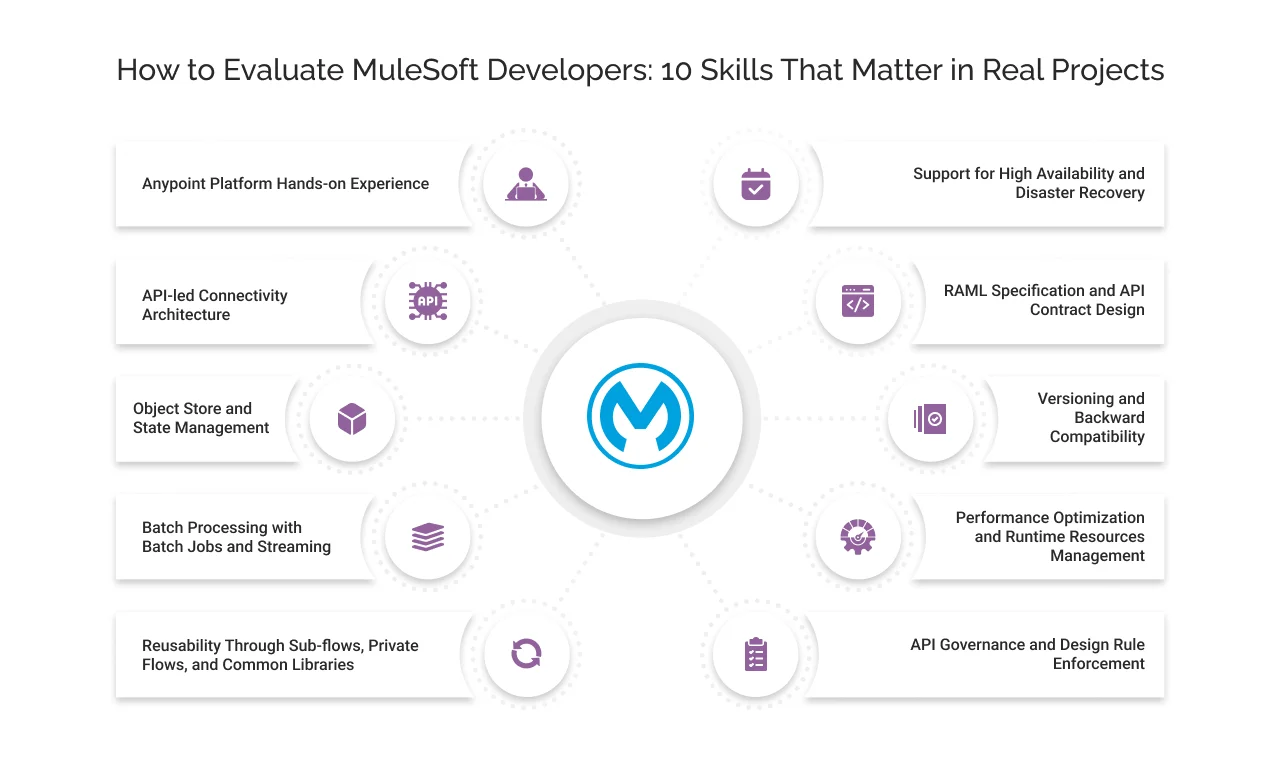
A developer must have proven hands-on experience working on the Anypoint Studio, Exchange, Runtime Manager, and API Manager. So, look beyond hiring a mulesoft developer, strive for specialization.
This platform helps to develop flows, manage dependencies, deploy applications, and monitor runtimes.
This is an essential skill to look after because the role of a developer doesn’t end at coding. The developer must have to manage deployments, configuration changes, and runtime behavior across environments.
You can evaluate the developer’s skills by asking the developer to walk through the end-to-end lifecycle of an application, from local development to production monitoring. The developer should help you with references to environment properties, runtime settings, and logging to signify platform experience.
This skill is about designing the integrations driven by the layered APIs, including System APIs, Process APIs, and Experience APIs. Simply saying, it refers to the separation of integrations into System APIs, Process APIs, and Experience APIs, each with a defined responsibility.
This is an essential skill because incorrect API responsibility assignment leads to duplicated logic and reduced reusability. Therefore, it is a must to have correct API segmentation that enables independent versioning, controlled dependency flow, and governance enforcement.
You can evaluate these skills by asking the developer to define API boundaries for a multi-system use case, along with an explanation of how each API layer interacts with the Mule application network.
This skill is about authoring RAML specifications that define resources, HTTP methods, request and response schemas, reusable data types, traits, and systematized error structures.
You should evaluate this skill because MuleSoft generates an API framework directly from RAML. If there is an inconsistent resource modeling or a schema definition may result in issues across generated flows.
The best practice to evaluate this MuleSoft developer skills is to review a RAML file for the right use of versioning, reusable components, HTTP status codes, and error modeling aligned with MuleSoft API design guidelines.
If you need to hire a MuleSoft developer to manage large volumes of data, then the developer must have experience in using batch jobs, batch steps, and record-level processing.
Enterprise integration often requires frequent involvement in bulk data movement. Additionally, they require processing large payloads synchronously, instead of using batch components, which leads to memory exhaustion and timeouts.
This skill can be evaluated by asking when to use batch jobs versus streaming and how record-level failures are handled within batch steps.
MuleSoft developers use the Object Store v2 to ensure state persistence, caching, rate limiting, and token storage.
Mule applications are stateless by default. Therefore, Object Stores are a must to ensure a controlled persistence across requests and worker restarts.
You can evaluate this skill by asking when to use Object Store versus in-memory variables and how TTL and eviction policies are managed.
Mule applications structuring often takes place using sub-flows, private flows, and shared assets published to Anypoint Exchange. Therefore, it is a must to evaluate this skill. Additionally, this skill matters more because duplication increases maintenance effort. Reusable components ensure consistent behavior across applications.
You can evaluate this skill of the developer by asking how common logic is shared across Mule applications and how dependencies are versioned.
The Mule applications your developer builds should be able to support high availability using multiple workers, in addition to regional deployment strategies.
You can evaluate the skill of a MuleSoft developer by asking how the developer can help you ensure protection against fault tolerance and recovery scenarios.
This is one of the must-have skills to look for when hiring a MuleSoft developer, especially on contract from a staff augmentation company.
The developer should have proven experience in configuring the Mule application with the help of streaming, non-blocking operations, and appropriate event processing strategies within allocated worker memory and vCore limits.
As you know, the Mule application runs utilizing the fixed runtime resources. So, if an application has poor payload handling or blocking operations, then the result will be in-memory pressure and reduced concurrency.
This skill can be evaluated by discussing scenarios involving large payloads, concurrent requests, or worker scaling, and how the developer addressed runtime constraints.
The MuleSoft developer should have expertise in applying governance rules using Anypoint API Governance to enforce naming conventions, security policies, and design standards.
This skill matters because unmanaged APIs lead to inconsistency and security risks across the integration landscape.
The simplest way to practice is to evaluate the developer’s skills by asking questions related to how design rules are applied during API development and validating before deployment. Additionally, you can ask for manual reviews without governance tooling.
The MuleSoft developer you hire should have skills in managing APIs and Mule application versioning while maintaining compatibility for existing consumers. This skill should be evaluated because the MuleSoft APIs are often consumed by multiple clients simultaneously.
You can evaluate this skill by asking how breaking changes are introduced. The developer’s answers should include parallel deployments and controlled version exposure.

These were some of the essential skills to consider when hiring a MuleSoft developer. Evaluating these skills of developers will help you design an integration that promises high availability.
Looking to hire a MuleSoft developer? At Smart IT Staff, we have a pool of MuleSoft developers with 5 years of an average experience working on the platform. You can hire a developer from Smart IT Staff within 0-2 days.

Access a team of certified IT professionals.
Let us know the skills you want to augment your organization, and we’ll help you fill the skill gap rapidly.

By submitting the form, you consent to Smart IT Staff processing your information in accordance with the Privacy Policy. Your information is safe with us, and we will use it for the intended purposes only. You can opt out of email updates at any time.